
Taken from V&A blog, originally posted on 4 December 2025
An important early chapter in Kazumi Arikawa’s lifelong pursuit of beauty unfolded in the galleries of the V&A. His first encounter with the museum proved to be transformative. Standing before the museum’s extraordinary jewellery collection, he described experiencing a ‘heart-shaking’ moment. ‘It is in the face of such divine beauty,’ he writes, ‘that the soul begins to tremble.’ That moment revealed to him the emotional power that jewellery can hold and how beauty, history, and artistry can come together in a single, luminous object.
That revelation would shape the course of his life. Kazumi Arikawa’s journey has been guided by a single, unwavering pursuit: beauty. Born in Japan, his path to becoming one of the world’s most renowned jewellery collectors was anything but straightforward. His early years were shaped by monastic training, an experience that strengthened his sense of discipline and contemplation. After leaving the monastery, he joined his mother’s jewellery business and soon realised he had found his calling.
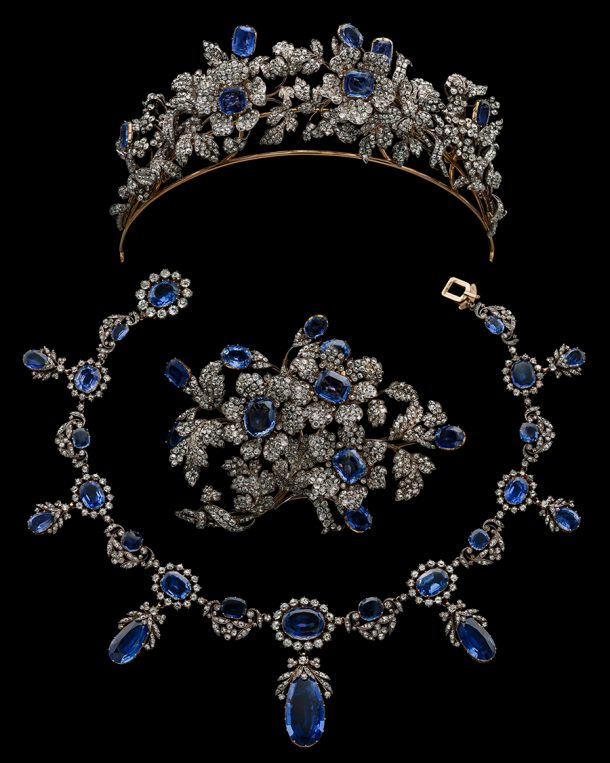
From then on, Arikawa dedicated his life to the pursuit of beauty and through his Tokyo-based gallery, Albion Art, he has spent decades collecting exceptional jewels from across time.
His collection, known as the Albion Art Collection, includes world-class pieces that range from ancient, engraved gems to designs from the early twentieth century. He never confines himself to a particular era or style. What matters, he says, is the ‘beauty and heart-stirring emotion’ that a jewel can inspire.
He often speaks about his fear that the world’s natural wonders are fading, and that the splendour of jewellery can help sustain the human spirit. This belief in beauty’s universality lies at the heart of his philosophy. ‘Truth,’ he says, ‘is ever adorned by beauty.’

Select highlights from this exceptional collection, entitled ‘Divine Jewels’, are on display at the V&A until April 2026. Amongst them, an important group of cameos, one of Arikawa’s favourite forms of jewellery. Cameos are miniature sculptures carved in relief, often from layered materials such as shell or sardonyx, whose natural contrasts of colour bring depth and movement to the design. It is an art that demands extraordinary precision, especially at a miniature scale. The technique flourished in ancient Rome, latterly seeing a renaissance in the 18th and 19th centuries, when European artists once again looked to the ideals of classical antiquity.

One example in the collection is the cameo of Bacchus by Nicola Morelli (1771 – 1838). Morelli was especially celebrated for his layered use of sardonyx and his approach to introducing tonal variation into his carvings. The minute transitions between the strata of the stone allow him to articulate different aspects of the portrait, such as depicting the bunch of grapes in a light translucent brown on top of white vine leaves. The colours, contrasts and textures of the carving create a cameo which feels animated from within, demonstrating why Morelli was so popular and sought after.

Likewise, the cameo of Minerva, engraved by Benedetto Pistrucci (1783 – 1855), executed in meticulous relief after the celebrated Minerva Giustiani statue. Pistrucci is best known as the master engraver behind the St. George and the Dragon design for the British Mint. His adaptation of Minerva captures and reinterprets the large-scale statue into the intimate format of an engraved gemstone.

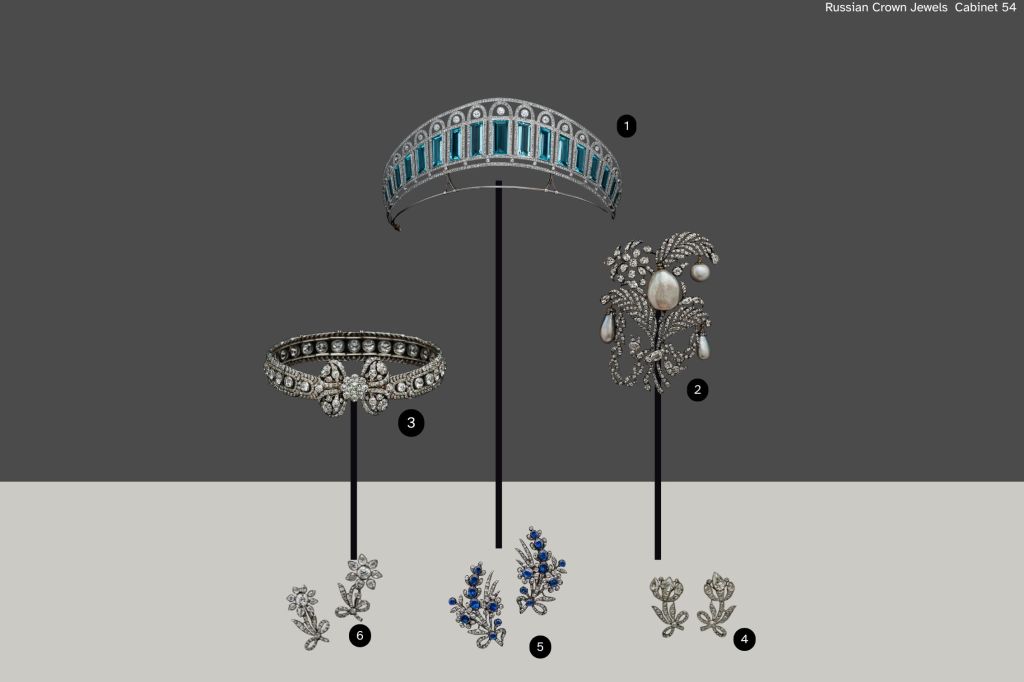
The Russian Imperial Jewels form one of the most significant groups within the display. Previously part of the Russian Crown Jewels, these pieces show the central role jewellery played in Russian court. At the heart of this group is the Pearl Brooch. Created in the mid 18th century under Empress Elizabeth Petrovna (ruled 1741 – 62) or Catherine II (Catherine the Great, ruled 1762 – 96), it takes the form of an aigrette, a courtly hair ornament which was often designed in the form of feathers. It is recorded in the 1925 catalogue made by Alexander E. Fersman for the Soviet state, which sought to document the imperial collection after its nationalisation following the revolution. Published under the title ‘Russia’s Treasure of Diamonds and Precious Stones’, this official inventory describes it as ‘a very artistic specimen of the jeweller’s art of the Elisabethan epoch.’

From the same period comes a remarkable diamond choker necklace, made around 1760 during the reign of Catherine II. The scale and quality of its diamonds suggest it was likely part of Catherine’s own collection, and it stands today as one of the great 18th-century Imperial Russian survivals. It also appears in Fersman’s 1925 catalogue, where the diamonds of the choker are described as ‘rare and antique stones, beautifully matched,’ and its bow-shaped clasp as ‘worthy to be exhibited in a museum.’ These contemporary assessments underline the exceptional quality of the piece and its significance within the Imperial collection.

A highlight among the later jewels is the aquamarine and diamond tiara by Koch, with its transparent, watery blue hue. With shops in Frankfurt and Baden-Baden, Koch supplied many of the royal courts and leading aristocratic families of Europe, and their workshop produced hundreds of technically fantastic tiaras, crowns and headbands. The allure of the tiara lies not only in the colour but also in the perfectly graduated and precisely calibrated cuts of the stones, each cut as an angled rhombohedron, creating a captivating rhythm of light. The aquamarines are set in a kokoshnik-shaped tiara (a traditional Russian headdress styled after the shape of a “cockscomb”) crafted in platinum and further adorned with diamonds. Importantly, this tiara belonged to Empress Alexandra Feodorovna (ruled 1894 – 1917), the last Empress of Russia. Its presence in her personal jewel inventory situates it within the world of the late Romanov courts, where jewellery was used as a marker of status, but also fulfilled a deeply personal role.

Also included are three different pairs diamond spray brooches, one set is shaped as tulips with ribbon-bow stems. The tulips originally belonged to Empress Elizabeth and later to Catherine II (Catherine the Great) and were part of the jewels displayed in Catherine’s celebrated Brilliant Room at the Winter Palace.

Tiaras form an important part of the Albion Art collection and the ‘Divine Jewels’ exhibit. Examples displayed illustrate changing styles and techniques from the 19th to the early 20th century, particularly the move towards lighter settings made possible by platinum. One earlier example is the impressive naturalistic diamond wild rose tiara set in silver and gold, designed in the 1880s by E. Wolfe and Co. Its natural forms and glittering diamonds make it appear almost alive, catching the light with every turn of the head. The magnificence of this tiara shows why E. Wolfe and Co. quickly became known in England as the ‘Tiara Makers’. The firm created pieces for prominent royal and aristocratic figures, including completing the Cambridge Lover’s Knot Tiara, which was famously worn by Diana, Princess of Wales.

The Monson Tiara, crafted in platinum, reflects the Garland Style. Jewels of this period often featured ribbon, bow, and foliate motifs, relying on platinum’s strength to hold stones with minimal visible metal so that diamonds create a continuous, luminous surface. Its name derives from its original owner, Romaine Stone, an American socialite who married Augustus Monson, 9th Baron Monson in 1903, around the time this tiara was made. Stone was one of the so-called ‘dollar princesses,’ American heiresses whose marriages into the English aristocracy helped revitalise declining family fortunes.

Many of the jewels also tell remarkable royal stories. One particularly touching group once belonged to Queen Victoria, a figure deeply connected to the history of the V&A itself. A gold bangle she gifted to her niece Stephanie in 1858 bears a personal inscription: ‘Meine theuren Nichte Stephanie von Victoria R. (9ten Mai 1858).’ It was a keepsake given to mark Stephanie’s royal marriage to King Peter V of Portugal. Nearby, a set of medallions and pendants from Queen Victoria and other royals marks birthdays, christenings, and moments of mourning, revealing the intimate and emotional side of royal life.

It is rare to see a collection that spans so many periods, styles, and techniques while maintaining such exceptional quality. Shown together at the V&A, these jewels reveal the discerning eye behind their assembly and the belief that beauty can sustain the human spirit. As Arikawa reflected, ‘Truth is ever adorned by beauty.’ For him, the importance of jewellery is about beauty, emotion, and the possibility of touching something divine. The feeling he once experienced in the V&A galleries, his ‘heart-shaking moment,’ now comes full circle as his own collection enters the museum for this magnificent temporary display. ‘Divine Jewels’ invites us to look closely, slow down and rediscover the beauty of the world through the beauty of jewellery.
Divine Jewels is on display in the Jewellery Gallery from December 2025 to April 2026. Explore the pieces mentioned here, and many more, through Explore the Collections.
Highlights


 Studio Vogel
Leave a comment